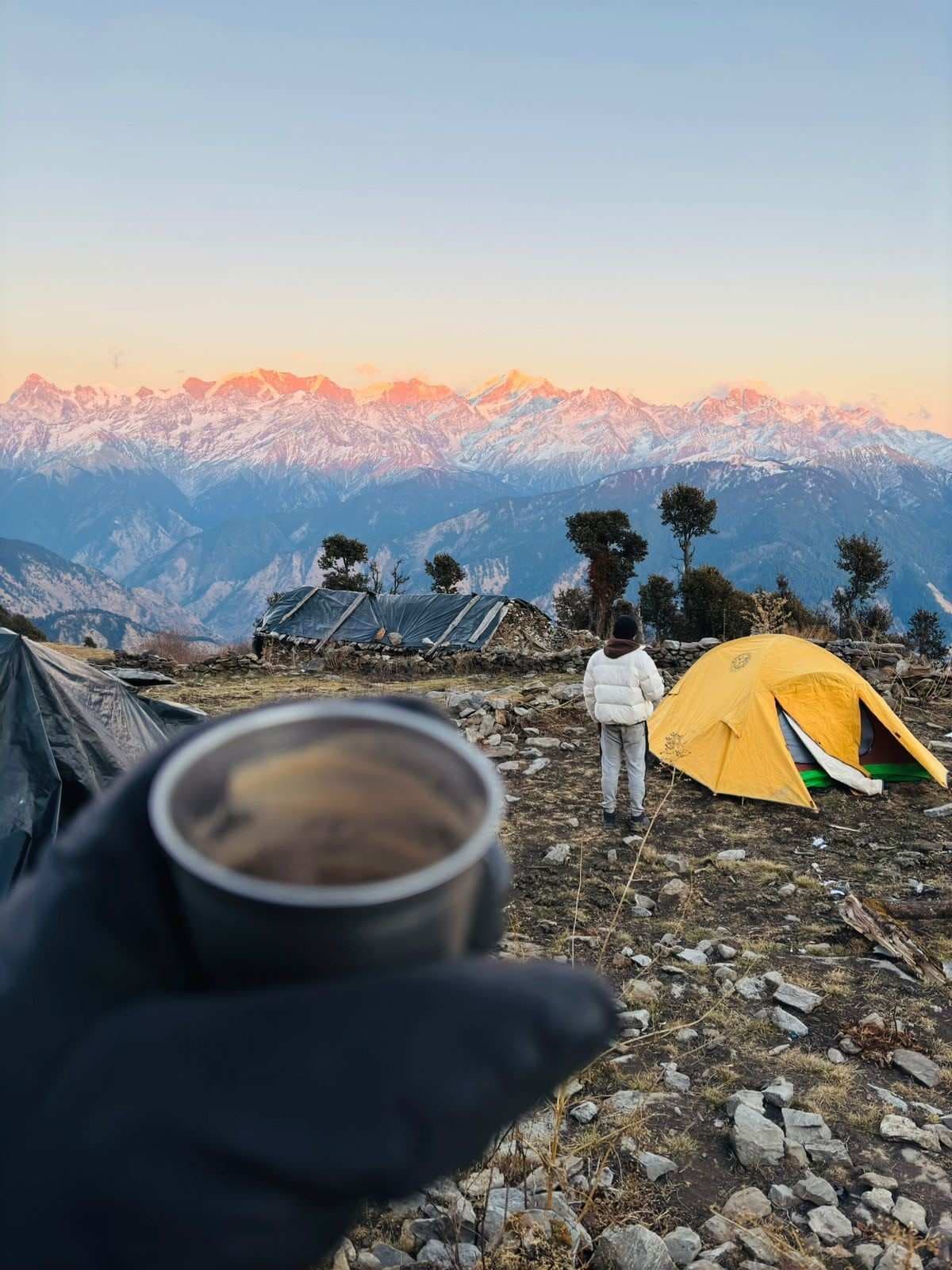
Vast 28 sq km Alpine Meadow — One of India's Largest High-Altitude Bugyals
The single defining feature of the Dayara Bugyal Trek is the meadow itself — and its scale is genuinely difficult to communicate in words. At 28 square kilometres, Dayara Bugyal is one of the largest continuous alpine meadows in the Indian Himalayas. When you step out of the forest on Day 3 and into the open bugyal, the visual impact is immediate: a vast, rolling expanse of meadow in every direction, with the horizon defined not by trees or ridgelines but by Himalayan peaks.
In summer and early autumn, the meadow is a rich green — grass that moves in the mountain wind like a slow wave. In late spring, it is dotted with wildflowers in pink, yellow, purple, and white. In winter and early spring, it is buried under deep snow, creating a completely white landscape that is equally extraordinary and feels utterly unlike any other trekking environment.
The absence of trees above the treeline — which is where Dayara Bugyal sits — means the sense of open space is total. There is no horizon obstruction. The sky feels immense. Standing in the middle of the bugyal and turning slowly to take in the full 360° is one of the most immediate and powerful experiences available on any beginner trek in India.
360° Himalayan Views — Bandarpunch, Black Peak, Srikanth, Jaonli, Draupadi ka Danda, Gangotri Range
Dayara Bugyal's position in the Garhwal Himalayas gives it an extraordinary panoramic view that is rare even among high-altitude treks. The meadow acts like a natural viewfinder, offering unobstructed sightlines across the entire western Garhwal range.
From the meadow and especially from Dayara Top (Bakariya Top), the peaks visible include:
Bandarpunch (6,316 m) — the "monkey's tail" peak, silver-white and dominant against the north-eastern sky
Black Peak (Kala Nag, 6,387 m) — a sharp, dark pyramid that stands distinctly against the snow-white range
Srikanth Peak (6,133 m) — a graceful pyramid visible from the meadow
Jaonli Peak (6,632 m) — one of the higher peaks in the immediate range
Draupadi ka Danda (5,716 m) — named for the Mahabharata's Draupadi
Gangotri range — the chain of peaks above the Gangotri Glacier, source of the Ganga, visible across the horizon on clear days
On exceptionally clear days in October and November, the entire panorama from Gangotri to Yamunotri is visible from the meadow — a 180° sweep of the western Garhwal Himalayan range that photographers and mountaineers rate as one of the finest accessible viewpoints in Uttarakhand.
Dayara Bugyal in Winter — Natural Snow Playground and Ski Slopes
From December through March, Dayara Bugyal transforms completely. The vast meadow, which is open grass in summer, becomes a deep snow landscape — typically covered in 3–6 feet of accumulated snow by January. The rolling terrain of the bugyal — gentle slopes, open bowls, natural ridgelines — creates what is effectively a natural ski slope accessible to anyone willing to trek in.
This is one of the few places in India where skiing in a genuine high-altitude mountain setting is accessible without a ski resort infrastructure. The Uttarkashi-based Nehru Institute of Mountaineering (NIM) has historically used Dayara Bugyal for snow activities and introductory skiing courses.
For trekkers who come in winter, the experience is dramatically different from summer: the trail from Raithal to Gui camp passes through snow-laden forest, the Gui Lake (Bachha Kund) is frozen solid, and the open meadow at Dayara is a completely white, pristine snow landscape with the peaks rising directly above. Night temperatures drop to –10°C at camp. The visual drama is extraordinary.
This winter version of the Dayara Bugyal trek is increasingly popular with trekkers from Delhi and other cities who want a genuine snow experience without the altitude and difficulty of Kedarkantha. It delivers: the snow is deep, the views are clear, and the meadow landscape in snow is unforgettable.
Gui Lake (Bachha Kund) — Scenic Frozen Alpine Lake Near the Campsite
Gui Lake — known locally as Bachha Kund — is a small alpine lake situated near the Gui campsite at approximately 2,900 metres. It is a short walk from the main campsite and is one of the most photogenic spots on the Raithal route.
In winter (December–February), Gui Lake freezes completely. The ice surface is typically 15–20 cm thick by January — solid enough to stand on, though trek guides generally advise against walking on the ice for safety. The frozen lake, surrounded by snow-covered deodar trees and backed by glimpses of the higher peaks, is one of the most photographed spots on the Dayara Bugyal trek.
In summer, the lake is open water — small, clear, and reflecting the surrounding forest and sky. A contemplative stop here in the late afternoon of Day 2 — after setting up camp and eating lunch — is one of the quiet pleasures of this trek that many trekkers mention as a memorable moment.
The lake is also ecologically significant — part of the Govind Wildlife Sanctuary's watershed, it supports the vegetation and wildlife habitat that makes this region so diverse.
Barnala Tal — Picturesque Lake at the Barsu Route Campsite
On the alternate Barsu route, Barnala Tal is the equivalent of Gui Lake — a small, picturesque alpine lake situated at approximately 3,014 metres near the Barnala campsite. The lake sits in a natural forest clearing above the treeline and is consistently described by trekkers on the Barsu route as one of the most beautiful campsites on any Uttarakhand beginner trek.
Barnala Tal in winter is frozen — a classic alpine winter scene. In summer, it is clear and reflective, with the surrounding meadows visible in the water. The Barnala campsite itself is set beside the lake, making it one of the finest lakeside camping spots available on any easy Uttarakhand trek.
For trekkers choosing the Barsu route specifically for the lake experience, Barnala Tal is the centrepiece. Its combination of lake, meadow views, and the approach through the Barsu forest makes the alternate route's reputation for beauty entirely justified.
Dense Oak, Rhododendron and Deodar Forest Trail
Before the meadow begins, the Dayara Bugyal trail passes through some of the most beautiful forest in the Uttarkashi district. From both Raithal and Barsu, the trail spends 2–3 hours in dense oak, rhododendron, maple, and deodar forest before emerging above the treeline.
The forest trail is the section that most surprises trekkers on their first Dayara Bugyal experience. After the initial village and terraced-field section from Raithal, the path enters dense forest that has been relatively undisturbed. Tall oaks form a canopy overhead. Rhododendrons crowd the lower layer. In winter, the entire forest is loaded with snow — branches bent and white, the trail a packed snow corridor through an otherwise silent white world.
In spring (April–May), the rhododendron trees bloom simultaneously throughout the forest — deep red-orange flower clusters on every tree, the path scattered with fallen petals. The forest walk during the rhododendron bloom is one of the finest visual experiences on any trek in Uttarakhand, and many trekkers specifically time their Dayara Bugyal visit for this period.
The forest is also habitat for most of the trek's wildlife — Himalayan Monal pheasants, foxes, and snow pigeons are most frequently seen in this zone.
Raithal and Barsu Villages — Traditional Garhwali Base Camps
Raithal and Barsu are two small Garhwali villages in the Bhagirathi River valley, Uttarkashi district — the base camps for the Dayara Bugyal Trek. Both villages sit at approximately 2,200 metres, surrounded by terraced fields, forest, and the sound of the Bhagirathi River in the valley below.
Raithal is the more commonly used starting point. It is a slightly larger village with a greater number of guesthouses and homestay options, a small market area, and reliable BSNL mobile connectivity. The Raithal homestays are genuinely warm — families open their homes to trekkers and serve traditional Garhwali cooking that is far better than the packaged food on most longer treks.
Barsu is smaller and quieter, with fewer formal facilities but a more intimate atmosphere. Trekkers who stay at Barsu homestays often describe the experience as their favourite part of the entire trek — sitting with a Garhwali family beside a wood fire, eating gahat dal and mandua roti, watching the stars from the village.
Both villages offer a genuine first experience of traditional Garhwali mountain culture — the stone-and-wood architecture, the terraced farming, the local dialect, the easy hospitality of communities that have been hosting travellers and shepherds on this trail for generations.
Photography Paradise — Wildflowers, Stargazing, Golden Hour Peaks
Dayara Bugyal is one of the most photographically rich beginner treks in India — with different compelling subjects available in every season and at every time of day.
Wildflowers (April–June): The meadow is carpeted with Himalayan wildflowers — primulas, anemones, various composites in yellow and white — alongside the rhododendron bloom in the lower forest. The combination of flower carpets and snow-capped peaks behind them is one of the most sought-after photographic compositions in Uttarakhand trekking.
Stargazing (year-round): At 2,900–3,400 metres, far from any town, the night sky at the Gui or Barnala campsite is extraordinary. The Milky Way is clearly visible to the naked eye. Astrophotographers specifically seek out this trek for the combination of altitude, dark skies, and mountains on the horizon for foreground.
Golden hour peaks (dawn and dusk): The Himalayan peaks visible from Dayara Bugyal catch the first light of sunrise and the last light of sunset differently — the faces of Bandarpunch and Black Peak turn from grey to orange to pink as the sun rises, and repeat the transition in reverse at dusk. No camera filter can match what you see with your eyes on a clear morning from the Dayara Bugyal meadow.
Andhuri (Butter Festival) — Unique Garhwali Cultural Festival Celebrated Here
The Andhuri Utsav — the Butter Festival of Dayara Bugyal — is one of the most unique cultural events associated with any trek in the Indian Himalayas. Held annually in August, this traditional Garhwali festival takes place on the meadow itself.
The festival involves local communities from the surrounding Bhatwari and Uttarkashi villages coming up to the bugyal with their livestock for a traditional celebration. Activities include folk music, dance in traditional Garhwali attire, butter-making demonstrations (hence the name), and community prayers. The meadow during the Andhuri festival is a rare combination of natural beauty and living cultural practice — the colourful traditional clothing of the participants against the green meadow and white peaks creates an extraordinary atmosphere.
Most trekking groups don't plan specifically for the festival — it coincides with the monsoon period when the trail has more cloud cover — but trekkers who encounter it describe it as one of the most unexpected and memorable experiences of the trek.