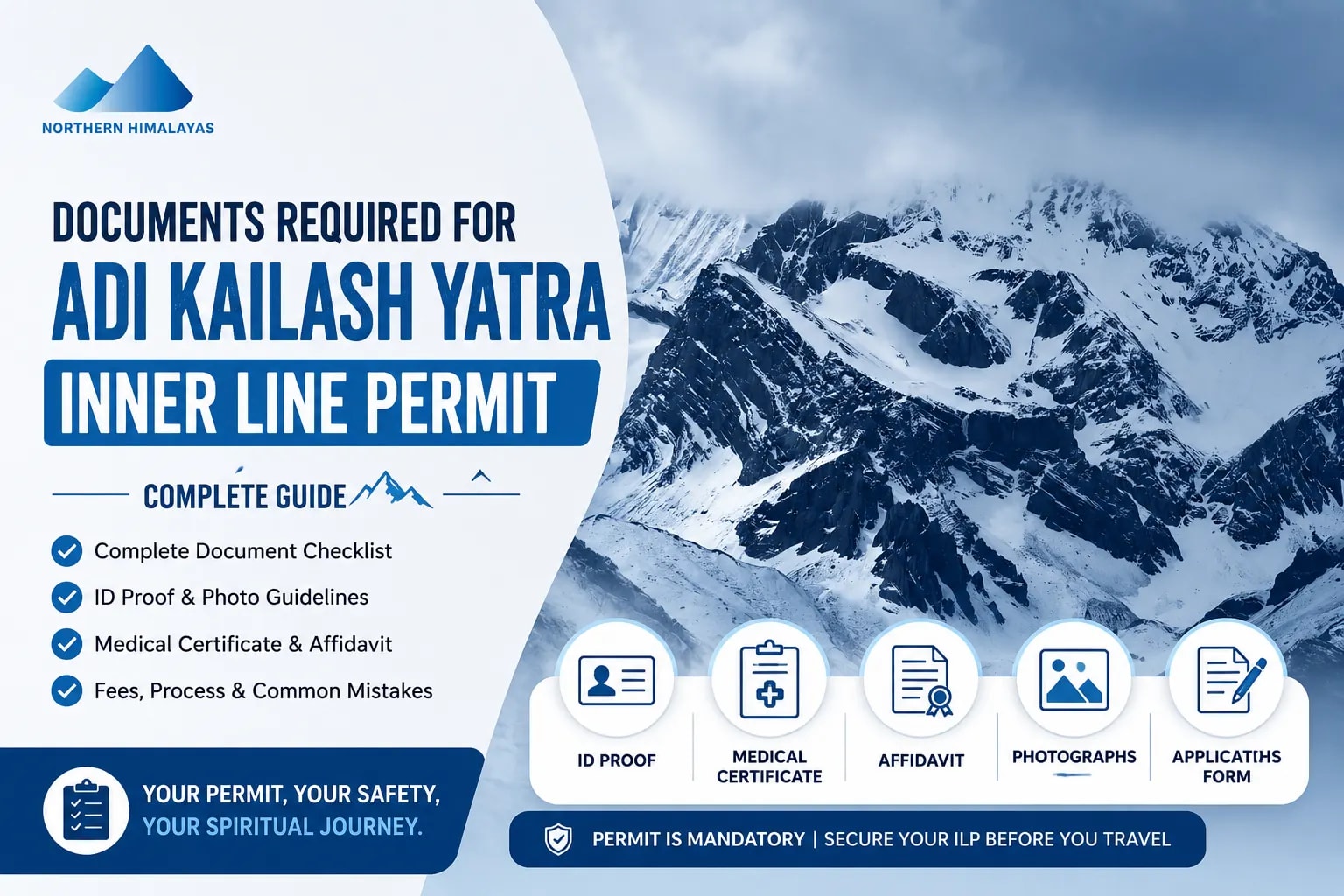
Planning the Adi Kailash yatra sounds exciting—until you reach Dharchula and realise your journey can stop before it even begins. Not because of fitness. Not because of weather. But because of paperwork.
The Documents Required for Adi Kailash yatra Inner Line Permit are not just a formality—they are mandatory due to the region’s proximity to the Indo-Tibetan border. Every year, many trekkers face delays or rejection simply because one document is missing or incorrect.
If you’re planning this journey in 2026, this guide will walk you through everything:
-
Exact ILP document checklist
-
Real ground-level permit process
-
Fees, timelines, and verification points
-
Common mistakes that lead to rejection
-
How operators like Northern Himalayas manage everything
By the end, you won’t need to search anything else about Adi Kailash permits.
What is the Adi Kailash Inner Line Permit (ILP) and Why is it Required?
The Inner Line Permit (ILP) is an official travel document issued by the Government of Uttarakhand that allows Indian citizens to enter restricted areas located near the international border with Tibet and Nepal. The Adi Kailash and Om Parvat region falls within the Pithoragarh district, a zone where national security is paramount.
The requirement for an ILP serves several vital purposes:
-
Security and Surveillance: Being a border region, the government needs to monitor the movement of every individual to prevent unauthorized crossings or illegal activities.
-
Safety Tracking: High-altitude trekking is inherently risky due to unpredictable weather and terrain. The ILP acts as a registry that helps the Indo-Tibetan Border Police (ITBP) and local administration track trekkers in case of emergencies or natural disasters.
-
Environmental Regulation: The permit system prevents mass tourism from overwhelming the pristine and ecologically fragile Himalayan ecosystem.
Without this permit, entry beyond the town of Dharchula is strictly prohibited. Checkposts at Tawaghat, Gunji, and Kalapani will deny entry to anyone failing to produce a valid, stamped ILP.
Complete List of Documents Required for Adi Kailash Yatra Permit
To secure your entry into the Vyas Valley, you must prepare a comprehensive dossier. In 2026, authorities have standardized the requirements to avoid confusion at the SDM (Sub-Divisional Magistrate) office in Dharchula.
The mandatory document checklist includes:
-
Government-Issued Photo ID: Original and at least 4-5 clear photocopies.
-
Medical Fitness Certificate: Issued by an MBBS-qualified doctor within the last 15-30 days.
-
Police Verification Certificate: A character clearance from your local police station or the Dharchula station.
-
Notarized Affidavit: A legal self-declaration on stamp paper regarding the risks of high-altitude travel.
-
Passport-Sized Photographs: 4-6 recent colored photos with a plain background.
-
Application Form: The official ILP form, which can be collected from the SDM office or downloaded online if using the state portal.
ID Proof Requirements for Adi Kailash ILP (Accepted Documents)
While several government IDs exist, not all are equally preferred for border permits. The goal is to provide a document that clearly establishes both your identity and your permanent residential address.
Accepted ID Proofs:
-
Aadhaar Card: This is the most widely accepted and preferred document for the Adi Kailash permit. Ensure your Aadhaar is linked to your current mobile number and the photo is recognizable.
-
Voter ID Card: A reliable secondary option that clearly states your address.
-
Valid Passport: Ideal for identity, though sometimes officials may ask for an additional address proof if the address on the passport is old.
-
Driving License: Accepted at the discretion of the issuing officer, usually as a supplementary document.
Important Note: PAN Cards are often rejected as a primary ID because they do not contain a residential address. Always carry the original ID for physical verification at the SDM office and at every ITBP checkpost along the trek.
Medical Fitness Certificate: Format, Tests, and Approval Process
The trek to Adi Kailash takes you to altitudes exceeding 14,000 feet, where oxygen levels drop significantly. A medical fitness certificate is not just a permit requirement; it is a life-saving check.
The Required Format
The certificate must be issued on the doctor's official letterhead or the prescribed government format. It must clearly state that you are "Fit for high-altitude trekking and physically sound". Crucially, it must include the doctor’s name, MBBS registration number, and an official stamp.
Mandatory and Recommended Tests
To get this certificate, you should expect to undergo:
-
Blood Pressure Monitoring: To ensure you don't have untreated hypertension.
-
Oxygen Saturation (SpO2) Test: To check your body’s baseline oxygen levels.
-
ECG (Electrocardiogram): Often mandatory for trekkers above 50 years to rule out cardiac issues.
-
Chest X-Ray: Recommended if you have a history of respiratory issues.
Who Can Issue It?.
-
Registered MBBS doctor.
-
Government hospital preferred (adds credibility).
Common Rejection Reasons
-
Missing doctor stamp/signature.
-
Generic certificate (not mentioning altitude).
-
Old certificate (validity usually recent).
Ground Reality
At Dharchula:
-
Medical checks may be re-verified.
-
Doubtful cases can be rejected.
The medical certificate must be recent, typically issued within 15 to 30 days of your trek start date. Certificates older than a month are often summarily rejected.
Passport Size Photos Guidelines for Permit Application
While it seems simple, incorrect photographs are a frequent cause of delay in the permit process. The ITBP and SDM offices require these photos for their physical registers and the actual permit card.
Follow these strict 2026 guidelines:
-
Quantity: Carry at least 6 copies. You will need one for the application, one for the medical form, one for the police verification, and extras for any emergency permits. In remote areas, there are no photo studios. One missing photo can delay your process by a full day.
-
Background: Use a plain white or light blue background. Avoid patterned or dark backgrounds.
-
Recency: The photo must have been taken within the last 3 months. It should accurately reflect your current appearance (e.g., if you now have a beard, the photo should show one).
-
Clarity: The face should cover 70-80% of the frame. Avoid wearing hats, sunglasses, or large headsets in the photo.
The Role of Police Verification and Character Certificates in 2026
Given the sensitivity of the India-Tibet border, the government must ensure that visitors do not have a criminal record or any "adverse" reports in their history.
How to obtain your verification:
-
Home Town Verification: You can apply for a character certificate at your local police station in your city of residence. This is highly recommended as it saves 1-2 days in Dharchula.
-
On-Ground Verification in Dharchula: If you cannot get it done beforehand, you can apply at the Dharchula Police Station. However, this can be time-consuming during the peak yatra season.
The certificate should be on the official police letterhead with a signature from the Station House Officer (SHO). Ensure it is not more than 6 months old; however, for the best chance of approval, a certificate issued within 30 days is preferred.
Documents Required for Foreign Nationals (If Applicable)
Important Update for 2026: Currently, the Adi Kailash and Om Parvat region is restricted to Foreign nationals, including NRIs with foreign passports, are generally not permitted to enter the Inner Line Zone beyond Dharchula for this specific yatra.
In exceptional cases where special permissions are granted (such as for high-level research or diplomatic reasons), the requirements are:
-
Protected Area Permit (PAP): This is different from an ILP and must be applied for through the Ministry of Home Affairs (MHA).
-
Valid Indian Visa and Passport: Must be sponsored by a registered Indian tour operator.
-
Group Requirement: Foreigners usually must travel in a group of at least two and be accompanied by a registered guide.
For standard trekkers, if you do not hold an Indian passport or OCI/Aadhar, you will likely be stopped at Dharchula.
Notarized Affidavit and Self-Declaration: Important Legal Formats
This document protects authorities legally.
What It Includes
-
You are traveling at your own risk.
-
You accept high-altitude dangers.
-
You will follow government rules.
Format Requirements
-
Stamp paper (usually ₹10–₹50).
-
Notary signature.
Why It Matters
Without this:
-
Your permit may not be approved.
Tip
Prepare this in your hometown instead of Dharchula to save time.
Supporting Documents for Senior Citizens and Minors
High-altitude environments are particularly taxing for children under 12 and seniors over 60.
For Senior Citizens (Age 60-70):
-
Strict Medical Clearance: The medical certificate must explicitly state that the individual is fit for altitudes above 4,000 meters.
-
Compulsory ECG/Stress Test: Proof of a healthy heart is often a mandatory addition to the standard medical certificate.
-
Consent Form: A declaration signed by their next of kin acknowledging the specific risks for elderly trekkers.
For Minors (Below 18):
-
Parental Consent: A self-attested letter from both parents/guardians authorizing the travel.
-
Relationship Proof: A birth certificate or school ID that links the minor to the accompanying adult.
-
Accompanying Guardian: Minors cannot apply for an ILP individually; they must be part of a parent’s or guardian’s application.
Documents Required for Vehicle Entry Permits (Private vs. Commercial)
If you are planning to drive your own vehicle or use a commercial transport, separate permits are required for the vehicle to proceed past Dharchula.
For Private Vehicles (Self-Drive):
-
RC (Registration Certificate): Only SUVs (4x4 or high clearance) are generally allowed due to the rugged terrain.
-
Insurance & PUC: Must be valid and current.
-
Driving License: The driver must have a valid DL with hill driving endorsement if possible.
-
Permit Fee: An additional fee of roughly ₹500–₹1,000 is often charged for vehicle entry into the Inner Line Zone.
For Commercial Vehicles:
-
Restricted Entry: Often, only local commercial vehicles from the Dharchula region are allowed to ferry passengers to Gunji and beyond. Outsider commercial taxis may be stopped at Dharchula.
-
Operator Registration: The vehicle must be registered with the local taxi union and have valid state permits.
Note: most people prefer tour packages because vehicle permissions are complex in border areas.
How to Apply for Adi Kailash Permit: Step-by-Step Process
Navigating the bureaucracy can be daunting. Here is the exact workflow for 2026:
-
Step 1: Preparation: Collect your medical certificate and police verification at least 15 days before departure.
-
Step 2: Arrival at Dharchula: Plan to stay in Dharchula for at least 1-2 working days for permit processing.
-
Step 3: SDM Office Visit: Visit the SDM office early in the morning (usually 10:00 AM). Collect the physical form, fill it carefully, and attach your photos and document photocopies.
-
Step 4: Fee Payment: Pay the permit fee (currently ranging from ₹200 to ₹800 depending on the season and processing type).
-
Step 5: Document Verification: The clerk will verify your originals against the photocopies. You may be asked a few questions about your itinerary.
-
Step 6: Collection: Permits are usually issued by late evening or the following morning.
Offline vs Online Permit Process: What Documents Change?
In 2026, the Uttarakhand government has integrated the Adi Kailash permit into the eDistrict and KMVN portals, but the transition is still hybrid.
-
Online Process: You can upload digital scans of your ID, photo, and medical certificate. However, you must still carry the physical originals to Dharchula for final verification and stamping. The online process mainly speeds up the data entry at the SDM office.
-
Offline Process: Everything is handled at the SDM office counters. While it feels more "traditional," it allows you to clarify any document issues directly with the officer on site.
Common Mistakes in Documentation That Cause Rejection
Avoid these frequent pitfalls to ensure you don't lose your trekking window:
-
Expired Medicals: Submitting a health certificate that is 45 days old.
-
Blurry ID Copies: If the address or photo on your photocopy is not clearly legible, the permit will be rejected.
-
Mismatched Names: Ensure the name on your Aadhaar matches exactly with the name on your medical certificate and police verification.
-
Missing Doctor Registration: A medical certificate without the doctor’s registration number is considered invalid.
-
Incomplete Dates: Ensure your itinerary dates on the application match your actual travel window.
Document Verification at Checkposts: What to Carry During Travel
Once you have your permit, the paperwork isn't over. You will be stopped multiple times by the ITBP.
At every checkpost, keep this "Ready Pack" accessible:
-
Original Inner Line Permit: Do not pack this deep in your bag.
-
Original Aadhaar Card: To match against the permit.
-
Photocopies of ILP: Sometimes checkposts keep a copy for their records.
-
Medical Certificate Copy: To prove fitness if you appear to be struggling with altitude.
Major Checkpoints: Dharchula (Initial Check), Tawaghat, Gunji (Military Hub), and Kalapani (Final Security).
Tips to Prepare Your Documents Without Last-Minute Issues
-
Digital Backup: Scan all documents and save them in a Google Drive or WhatsApp folder. Mobile network is weak beyond Dharchula, so keep offline copies on your phone.
-
The "Lamination" Rule: Do not laminate your original permit. It needs to be signed/stamped at various points. Instead, keep it in a transparent waterproof folder.
-
Buffer Days: Always add 1 extra day in your itinerary for "Permit Contingency" in case the SDM is away or the office is closed on a public holiday.
Tips to Get Your Adi Kailash Permit Approved Without Hassle
The most effective way to handle this logistical headache is to delegate. Book your adi kailash trek with experienced operators like Northern Himalayas they handle permits, manage documents and all the entire process.
Why use an operator for permits?
-
Pre-Processing: They can often start your permit paperwork before you even reach Dharchula if you send them scans in advance.
-
Local Coordination: They handle the SDM office visits and local notary requirements, leaving you free to acclimatize or explore the town.
-
Error Checking: They know exactly which doctor registration numbers are accepted and will catch document errors before they reach the official desk.
By ensuring your Documents Required for Adi Kailash yatra Inner Line Permit are in perfect order, you move one step closer to the spiritual summit of your dreams. Preparation is the key to a peaceful pilgrimage.
FAQs
1. Is an Inner Line Permit mandatory for every trekker?
Yes, without exception. The region is a high-security border zone, and entry without a permit is a punishable offense.
2. Can I get a permit on a Sunday or Public Holiday?
Generally, the SDM office is closed on Sundays and National Holidays. Plan your arrival in Dharchula on a working day.
3. What is the total cost of getting an ILP in 2026?
The base fee is approximately ₹200–₹800, but including medical checkups, notarized affidavits, and agent fees, you should budget around ₹1,500–₹2,500 per person.
4. How long does the permit last?
Standard permits are issued for 7 to 15 days, specifically for the route requested.
5. Can I get an Adi Kailash permit in one day?
Usually no. It takes 2–4 days due to verification and approval.
6. Is Aadhaar mandatory?
Not mandatory but highly recommended as primary ID.
7. What happens if my permit is rejected?
You cannot proceed beyond Dharchula.
8. Can tour operators arrange permits?
Yes. Operators like Northern Himalayas manage the entire process.
9. Is police verification compulsory?
In most cases yes, especially for self-planned trips.