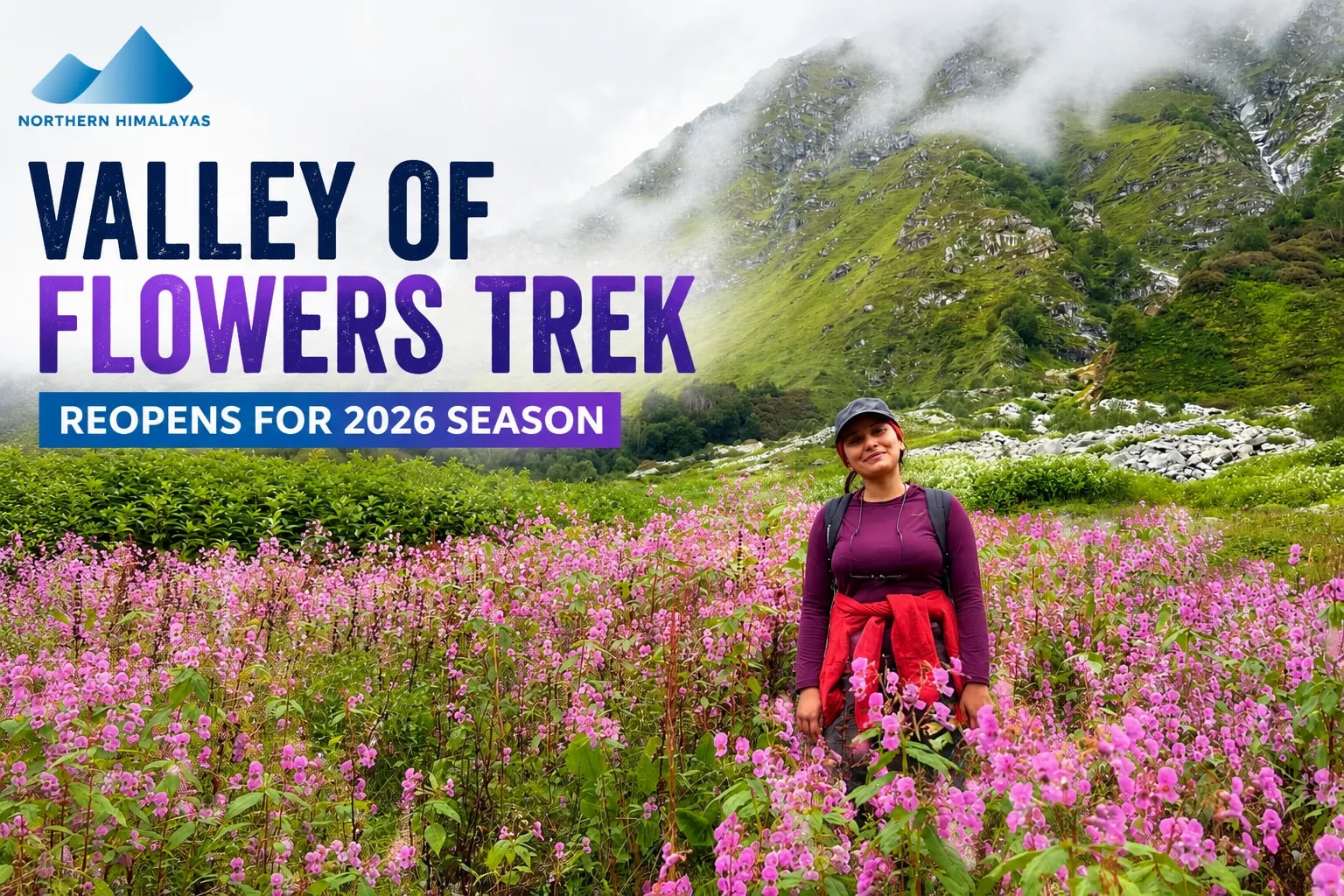
Planning the Valley of Flowers Trek in 2026? Join our upcoming batches with Northern Himalayas and let us take care of all arrangements, including accommodation, meals, transportation, permits, and trek guidance.
Table of Contents
- Valley of Flowers Trek — Latest Update for 2026
- About the Valley of Flowers
- Best Time to Visit Valley of Flowers
- Valley of Flowers Trek Itinerary (Including Hemkund Sahib & Optional Badrinath Extension)
- How to Reach Valley of Flowers
- Flowers Found in Valley of Flowers
- Hemkund Sahib — World's Highest Gurudwara
- Wildlife and Fauna in Valley of Flowers
- Permits, Entry Fees, and Visiting Hours 2026
- How to Get Forest Permits
- Where to Stay & Accommodation Along the Trek
- Trek Essentials — Complete Packing List
- Valley of Flowers Trek Cost and Budget
- Conclusion — Plan Your Valley of Flowers Trek 2026 Now
- FAQs About Valley of Flowers
Valley of Flowers Trek — Latest Update for 2026
The Valley of Flowers National Park officially reopened on 1 June 2026, marking the beginning of the much-awaited trekking season. After remaining closed throughout winter due to heavy snowfall, the gates have once again opened for visitors, and thousands of trekkers, photographers, nature lovers, and pilgrims have already started planning and visiting the valley from across India and abroad.
Known for its colourful alpine meadows, rare Himalayan flowers, breathtaking mountain views, and proximity to Hemkund Sahib, the Valley of Flowers remains one of the most popular monsoon treks in India.
Why the 2026 Season Is Special
This year, officials have reported excellent snowmelt and a good monsoon forecast, which means the floral bloom is expected to be exceptionally vibrant — particularly in July and August. Road connectivity has also improved after the Char Dham highway upgrades, making the Rishikesh–Govindghat stretch faster and smoother than previous years.
Closing Date: 4th October 2026
The valley closes every year in early October as snowfall begins at higher elevations. Plan your trip before 4th October to avoid the season ending on you. September is actually a lovely, less-crowded time to go.
Crowd Levels and Daily Visitor Cap
The forest department allows a limited number of trekkers per day to protect the fragile ecosystem. Typically, around 200–500 trekkers enter the valley daily during peak season. On weekends and during the mid-July to mid-August peak bloom period, that cap fills quickly. Book accommodation in Ghangaria in advance, especially for weekends.
Accommodation and Stay Facilities
Accommodation is available at:
-
Joshimath
-
Govindghat
-
Pulna
-
Ghangaria
Ghangaria serves as the main base camp for both the Valley of Flowers Trek and the Hemkund Sahib Yatra. The village offers hotels, guesthouses, lodges, and GMVN properties for visitors.
Road and Weather Conditions
The Valley of Flowers experiences typical monsoon weather during the trekking season:
-
June: Pleasant weather and fresh greenery
-
July: Frequent rainfall and increasing flower blooms
-
August: Peak flowering season with maximum floral diversity
-
September: Clear mountain views, pleasant weather, and fewer crowds
Road Conditions
Road connectivity up to Govindghat remains operational throughout the season. However, heavy rainfall can occasionally cause temporary delays due to landslides or road maintenance work. Visitors should check the latest road updates before traveling.
Forest Permits
Forest entry permits are mandatory. They are issued at the check post near Govindghat or Ghangaria. Do carry a government-issued photo ID (Aadhaar, passport, or voter card). The permit is valid for 3 days from the date of issue.
About the Valley of Flowers
The Valley of Flowers is one of the most beautiful trekking destinations in India. It is located in the Chamoli district of Uttarakhand and is famous for its colourful flower-filled meadows, waterfalls, snow-covered mountains, and stunning Himalayan views. Every year during the monsoon season, thousands of flowers bloom across the valley, turning it into a natural paradise.
The valley is situated at an altitude of around 3,658 metres (12,000 feet) and is part of the Nanda Devi Biosphere Reserve, one of the most important protected areas in the Himalayas. Because of its unique beauty and rich biodiversity, UNESCO declared it a World Heritage Site in 2005.
The trek to the Valley of Flowers starts from Govindghat and passes through Pulna and Ghangaria, which serves as the main base camp for trekkers. The valley covers an area of about 87.5 square kilometres and is surrounded by towering Himalayan peaks. The beautiful Pushpawati River flows through the valley, adding to its scenic beauty.
Although local villagers and shepherds had known about the valley for many years, it became famous around the world in 1931 when British mountaineer Frank S. Smythe discovered it while returning from a mountaineering expedition. He was amazed by the colourful flowers spread across the valley and later wrote a book called The Valley of Flowers, which helped introduce this hidden Himalayan gem to the world.
The Valley of Flowers Trek is considered an easy to moderate trek, making it suitable for beginners as well as experienced trekkers. No special climbing skills are required. The complete trek, including a visit to Hemkund Sahib, covers around 37 to 40 kilometres and is usually completed in 5 to 6 days.
The trail from Govindghat to Ghangaria is around 10–13 kilometres, while the trek from Ghangaria to the Valley of Flowers is about 4 kilometres one way. Many visitors also trek to Hemkund Sahib, a famous Sikh pilgrimage site located at 4,329 metres (14,200 feet), which is the highest point of the journey.
One of the reasons this trek is so special is that it is best visited during the monsoon season, when most Himalayan treks are less popular due to rain. Here, the rain brings life to the valley and helps thousands of flowers bloom. The best time to see the flowers in full bloom is usually from mid-July to mid-August, while September offers clearer mountain views and fewer crowds.
The Valley of Flowers is not just a trek; it is a complete Himalayan experience. Visitors get to enjoy colourful flowers, waterfalls, rivers, mountain views, wildlife, and the spiritual atmosphere of Hemkund Sahib, all in one trip. Whether you are a trekker, photographer, nature lover, or pilgrim, this trek offers an unforgettable experience.
Quick Facts
-
Location: Chamoli District, Uttarakhand
-
Altitude: 3,658 m (12,000 ft)
-
Highest Point: Hemkund Sahib – 4,329 m (14,200 ft)
-
Area: 87.5 sq km
-
Trek Difficulty: Easy to Moderate
-
Trek Duration: 5–6 Days
-
Total Trek Distance: Approximately 37–40 km
-
National Park Status: Since 1982
-
UNESCO World Heritage Site: Since 2005
-
Best Time to Visit: July to September
-
Opening Date 2026: 1 June 2026
-
Closing Date 2026: 4 October 2026
Best Time to Visit Valley of Flowers
The best time to visit the Valley of Flowers is from July to September, when the valley is covered with thousands of colourful flowers. However, each month offers a different experience, so the right time depends on what you want to see.
Month-by-Month Bloom Guide
June (1 June to 30 June)
The Valley of Flowers usually opens on 1 June every year. During this month, winter snow has recently melted, and the valley starts turning green. Flower blooms are limited, but you can still see some early flowering plants such as Primulas and Anemones.
June is a great time for travelers who:
-
Prefer fewer crowds
-
Enjoy peaceful trails
-
Want easier hotel availability
-
Like fresh greenery and clear mountain views
Although the valley is beautiful, it is not yet at its peak flowering stage.
July (Flowers Start Blooming Everywhere)
July marks the beginning of the main flower season. As the monsoon arrives, the valley slowly transforms into a colourful landscape.
By mid-July, many famous Himalayan flowers begin blooming, and the meadows become much more vibrant. Waterfalls become stronger, the Pushpawati River flows at full force, and the entire valley looks fresh and alive.
July is ideal if you want:
-
Large numbers of flowers
-
Green mountain landscapes
-
Waterfalls in full flow
-
Fewer crowds than August
Keep in mind that rainfall becomes more frequent during this month.
August (Best Month to Visit)
August is considered the best month to visit the Valley of Flowers.
This is when the valley reaches its peak bloom. Large areas of the meadow are covered with colourful flowers, creating one of the most beautiful natural landscapes in India.
During August, visitors can see:
-
Maximum flower diversity
-
Vibrant colours across the valley
-
Excellent photography opportunities
-
Peak Himalayan bloom season
Since it is the most popular month, hotels and guesthouses in Ghangaria often get fully booked, especially on weekends and holidays.
September (Clear Views and Fewer Crowds)
September offers a different but equally beautiful experience.
As the monsoon starts to retreat, rainfall decreases and the skies become clearer. Many flowers begin to fade, but the surrounding mountains become more visible.
September is perfect for travelers who want:
-
Clear Himalayan views
-
Pleasant weather
-
Less rainfall
-
Fewer tourists
-
Easier accommodation bookings
The valley may have fewer flowers compared to August, but the peaceful atmosphere and scenic mountain views make September a wonderful time to visit.
The Best Bloom Period
If your main goal is to see the valley covered with flowers, the best time to visit is between mid-July and mid-August.
During this period:
-
Most flower species are in bloom
-
The valley looks its most colourful
-
Photography conditions are excellent
-
Meadows are filled with flowers from one end to the other
Because this is the busiest period of the season, it is advisable to book accommodation in Ghangaria several weeks in advance.
Why Monsoon Is the Best Season for Valley of Flowers
Unlike many Himalayan treks that become difficult during the monsoon, the Valley of Flowers actually depends on monsoon rainfall.
The rain helps flowers bloom, keeps the meadows green, fills the rivers and streams, and creates beautiful waterfalls along the trail.
This is why the valley is most beautiful during the monsoon months.
While occasional rain showers are common, they are a small trade-off for witnessing one of the most colourful natural displays in the Himalayas.
Weather During Peak Bloom Season
-
Morning temperatures: 10–15°C — pleasant and clear
-
Afternoon: Cloud cover builds by 1–2 PM, showers begin
-
Night temperatures in Ghangaria: 5–8°C — carry warm layers
-
At Hemkund Sahib: 0–5°C even in July and August
Rain showers during monsoon typically last 1–2 hours and then clear. Carry a good quality rain poncho and waterproof trekking shoes.
Valley of Flowers Trek Itinerary (Including Hemkund Sahib & Optional Badrinath Extension)
Day 1 — Delhi / Rishikesh / Dehradun to Govindghat / Joshimath
Most trekkers travel overnight from Delhi to Rishikesh or Haridwar by bus or train, arriving early morning. From Rishikesh, it is a 10–12 hour drive (~295 km) through Devprayag, Rudraprayag, Chamoli, and Joshimath to reach Govindghat (or stay overnight in Joshimath to acclimatise).
Altitude: Rishikesh 372 m → Joshimath 1,890 m Drive Distance: ~295 km from Rishikesh Tip: Break the drive with a chai stop at Rudraprayag Sangam. Arrive in Joshimath by evening and sleep early.
Day 2 — Govindghat / Pulna to Ghangaria Trek
From Govindghat, a short 4 km drive (or walk) takes you to Pulna village, the actual trek starting point. From Pulna, the trail runs alongside the Pushpawati River for 9 km through forests, past small dhabas and waterfalls, up to Ghangaria.
Trek Distance: 9 km Altitude Gain: 1,900 m to 3,050 m Duration: 4–5 hours at a comfortable pace Mule/Porter Option: Available from Govindghat. Many older trekkers and families use mules for this section.
Day 3 — Ghangaria to Valley of Flowers and Back
This is the day you have been waiting for. Leave Ghangaria by 7 AM to reach the check post at the valley entrance early. The 4 km trail from Ghangaria to the valley entrance passes through forests and meadow edges before opening into the full valley.
Trek Distance: 4 km each way Valley Entry Hours: 7 AM to 2 PM (you must exit before 5 PM) Altitude: 3,050 m to 3,500 m Tip: Carry a packed lunch and plenty of water. Spend as much time inside the valley as possible. No staying overnight inside — return to Ghangaria by evening.
Day 4 — Ghangaria to Hemkund Sahib and Back
The toughest day of the trek. The trail rises steeply for 6 km from Ghangaria to Hemkund Sahib at 4,329 m. The altitude gain (~1,300 m) is significant and the air gets noticeably thin in the final 2 km.
Trek Distance: 6 km each way Duration: 8–9 hours for the full day Highlights: Glacial lake, Hemkund Sahib Gurudwara, Lokpal Temple, snow views, Brahma Kamal en route Tip: Start by 6:30 AM. Take it slow in the final 2 km. Descend before 2 PM due to afternoon weather.
Day 5 — Ghangaria to Govindghat / Pipalkoti (Optional Badrinath Visit)
Descend from Ghangaria to Govindghat (9 km trek, ~4 hours), then drive to Pipalkoti for overnight stay. Many trekkers add a detour to Badrinath (25 km from Govindghat) on this day — a beautiful Vishnu temple at 3,133 m with views of Neelkanth peak.
Note: Badrinath detour adds ~2–3 hours to the day but is highly recommended if you have time.
Day 6 — Return to Rishikesh / Dehradun
Drive back from Pipalkoti/Joshimath to Rishikesh (~200 km, 9–10 hours). Add a buffer day in your travel plan — monsoon landslides can cause delays on this mountain road, especially between Rudraprayag and Karnaprayag.
How to Reach Valley of Flowers
The journey to the Valley of Flowers begins from Govindghat, a small town located on the Badrinath Highway in Chamoli district, Uttarakhand. From here, travelers continue to Pulna Village, which is the actual starting point of the trek. The route then leads to Ghangaria, the base camp for both the Valley of Flowers Trek and Hemkund Sahib Yatra.
Nearest Base Camp — Govindghat and Pulna
Govindghat is the last major road-access point before the trek begins. It is situated at an altitude of 1,828 metres (6,000 feet) on the banks of the Alaknanda River.
From Govindghat, visitors can take a shared jeep to Pulna Village, located about 4 km away. Since private vehicles are not allowed beyond Pulna, all trekkers start their journey from here.
How to Reach by Bus
Delhi to Haridwar/Rishikesh
Regular buses operate from ISBT Kashmiri Gate, Delhi to Haridwar and Rishikesh.
-
Travel Time: 6–7 Hours
-
Fare: ₹400–₹700
-
Options: Volvo, AC, and Ordinary Buses
Rishikesh to Govindghat
From Rishikesh, GMOU and Uttarakhand Roadways buses run towards Badrinath via Joshimath and Govindghat.
-
Travel Time: 10–12 Hours
-
Fare: ₹600–₹900
Shared jeeps and local taxis are also available from Joshimath for the final stretch to Govindghat.
How to Reach by Train
The nearest major railway station is Haridwar Railway Station (HW), which is well connected to Delhi, Mumbai, Kolkata, Ahmedabad, Jaipur, and other major Indian cities.
Another option is Rishikesh Railway Station, though train connectivity is more limited.
From Haridwar or Rishikesh, you can continue your journey to Govindghat by bus, shared taxi, or private cab.
How to Reach by Air
The nearest airport is Jolly Grant Airport, Dehradun, located about 22 km from Rishikesh.
Regular flights connect Dehradun with:
-
Delhi
-
Mumbai
-
Bengaluru
-
Hyderabad
-
Other major cities
After landing, travelers can hire a taxi to Rishikesh and then continue towards Govindghat.
Tip: If you are arriving by flight, it is advisable to reach Rishikesh a day before your road journey, as the drive to Govindghat takes a full day.
Govindghat to Ghangaria Trek Route
From Govindghat, take a local jeep to Pulna Village.
The trek from Pulna to Ghangaria is approximately 9 km and follows a well-maintained stone-paved trail alongside the beautiful Pushpawati River.
Along the route, trekkers pass:
-
Waterfalls
-
Mountain streams
-
Tea stalls
-
Forest sections
-
Scenic valley views
-
Trek Distance: 9 km
-
Trek Duration: 4–5 Hours
-
Difficulty: Easy to Moderate
Helicopter Service (Govindghat to Ghangaria)
For senior citizens, families, and those who want to avoid the long trek, helicopter services are available between Govindghat and Ghangaria during the season, subject to weather conditions.
-
Flight Duration: 8–10 Minutes
-
Cost: Approximately ₹2,000–₹3,000 per person (one way)
Since seats are limited during the peak season, advance booking is recommended.
Hire a Cab or Taxi
Hiring a private cab is one of the most comfortable ways to reach Govindghat, especially for families and groups.
For reliable transportation, travelers can book taxis through Chamoli Taxi Service, which operates vehicles from:
-
Dehradun Airport
-
Haridwar
-
Rishikesh
-
Joshimath
-
Govindghat
Private cabs are available in various options, including sedans, SUVs, and Tempo Travellers.
Approximate cost from Rishikesh to Govindghat:
-
Sedan: ₹5,000–₹6,500
-
SUV: ₹6,500–₹9,000
-
Tempo Traveller: ₹12,000+ (depending on group size and season)
Shared taxis are also available from Joshimath to Govindghat at affordable rates.
Transportation Included in Valley of flowers Trek Packages
If you book your Valley of Flowers Trek Package with Northern Himalayas, you don't have to worry about arranging transportation separately.
Our Valley of Flowers packages include transport support from Rishikesh to Govindghat and return, along with accommodation, trek coordination, experienced trek leaders, and complete on-ground assistance. This makes the journey smoother and allows you to focus on enjoying the trek rather than managing travel logistics.
Whether you are traveling solo, with friends, or with family, booking a complete Valley of Flowers package is one of the easiest and most convenient ways to experience this beautiful Himalayan trek.
Flowers Found in Valley of Flowers
The Iconic Brahma Kamal — How and Where to Spot It
The Brahma Kamal (Saussurea obvallata) is Uttarakhand's state flower and one of the most spiritually significant blooms in the Himalayas. It is large, white, and unfurls its petals only after dark — making it a rare and mystical find for trekkers.
Brahma Kamal does not grow on the main valley meadow floor. Look for it:
-
On rocky terrain above 3,800 m
-
Near the steep sections of the Hemkund Sahib trail
-
Under large boulders and near seeping water streams
-
In shaded rocky crevices on the upper valley rim
A local guide will significantly improve your chances of spotting it.
Himalayan Blue Poppy
The Blue Poppy (Meconopsis aculeata) is perhaps the most photographed flower in the valley — a vivid, iridescent blue that feels almost unreal against the green meadows. It blooms primarily in July and August and is found in patches throughout the main valley floor.
Finding it in good morning light for photography is worth getting up at dawn for.
Other Rare Blooms — Cobra Lily, Anemone, Primula, Orchids
The valley hosts over 500 species, including:
-
Cobra Lily (Arisaema): A unique hooded bloom that looks almost like a snake
-
Anemone: Early bloomers, white and purple, visible even in June
-
Primula: Pale pink clusters that appear first as snow melts
-
Marsh Marigold: Bright yellow carpets near stream banks
-
Inula: Sunflower-like yellow blooms visible in August
-
Orchids: Clinging to cliff walls and rocky outcrops
-
Pedicularis, Polygonum, Geranium, Epilobium — covering every colour of the spectrum
How the Valley Changes Color Month to Month
One of the most fascinating aspects of the Valley of Flowers is how the colour palette shifts visibly with each passing month:
-
June: White and pale greens (Anemone, early Primula)
-
Early July: Purple and blue tones arrive (Blue Poppy, Geranium)
-
Late July–August: Full riot of colour — red, pink, yellow, orange, purple, white simultaneously
-
September: Warm amber and golden tones as flowers seed and dry
Each visit, even in the same season, offers a different visual experience.
500+ Species — A Botanist's Paradise
The valley holds approximately 520 species of alpine plants, of which 498 are flowering species. It is one of the richest concentrations of alpine flora anywhere in the Himalayas. Botanists, nature photographers, and researchers visit from across the world specifically to document new findings here. The valley has been a subject of ongoing scientific study since Frank Smythe first catalogued its plants in 1937.
Hemkund Sahib — World's Highest Gurudwara
About Hemkund Sahib
Hemkund Sahib is one of the most sacred Sikh pilgrimage sites in India and one of the highest Gurudwaras in the world. It is located at an altitude of 4,329 metres (14,200 feet) in the Garhwal Himalayas of Uttarakhand, near the Valley of Flowers.
The Gurudwara is dedicated to Guru Gobind Singh Ji, the tenth Sikh Guru. According to Sikh beliefs and references in Bachitra Natak (also known as Vichitra Natak), Guru Gobind Singh Ji meditated at this place in a previous life. Every year, thousands of Sikh pilgrims and trekkers visit Hemkund Sahib to seek blessings and experience the peaceful atmosphere of this high-altitude shrine.
One of the highlights of Hemkund Sahib is the beautiful Hemkund Lake, a crystal-clear glacial lake located beside the Gurudwara. Surrounded by snow-covered mountains, the lake remains frozen for much of the year. During the summer months, the ice melts, revealing stunning reflections of the surrounding peaks in its calm waters.
Trek to Hemkund Sahib
The trek to Hemkund Sahib starts from Ghangaria, the base camp shared with the Valley of Flowers Trek.
-
Distance: 6 km one way
-
Total Distance: 12 km round trip
-
Altitude Gain: Around 1,300 metres
-
Difficulty Level: Moderate to Difficult
-
Duration: 7–9 hours round trip
Although the distance is relatively short, the trail is steep and involves a significant climb in a short distance. Most trekkers find the Hemkund Sahib trek more challenging than the Valley of Flowers trail.
Spiritual Importance
Hemkund Sahib is important not only for Sikhs but also for Hindus.
Near the Gurudwara is the Lokpal Temple, which is dedicated to Lakshman Ji, the brother of Lord Rama. Because of this, the area attracts both Sikh pilgrims and Hindu devotees, making it a place of great spiritual significance.
Opening and Closing Dates
Hemkund Sahib remains open only during the summer and monsoon months.
-
Opening: Usually in late May or early June (depending on snow conditions)
-
Closing: Usually in early October
For the 2026 season, Hemkund Sahib is expected to remain open during the same period as the Valley of Flowers, though exact dates should always be confirmed through official sources before planning your trip.
Can You Stay Overnight at Hemkund Sahib?
No, overnight stays are not allowed at Hemkund Sahib.
All visitors must return to Ghangaria on the same day. Due to the high altitude, cold temperatures, and rapidly changing weather conditions, staying overnight at Hemkund Sahib is not permitted.
It is recommended to start your trek early in the morning and reach the Gurudwara by early afternoon. Most visitors begin their return journey to Ghangaria after spending some time at the shrine and lake.
Langar at Hemkund Sahib
One of the most memorable experiences at Hemkund Sahib is the free Langar (community meal) served by volunteers.
After the steep climb, pilgrims and trekkers can enjoy a simple, warm meal and tea while experiencing the spirit of Sikh hospitality and selfless service. The Langar is available to all visitors, regardless of religion, background, or nationality.
Hemkund Sahib is much more than a trekking destination. It offers a unique combination of spirituality, natural beauty, and adventure. Whether you visit for religious reasons or as part of the Valley of Flowers Trek, the peaceful atmosphere, sacred lake, and spectacular Himalayan scenery make it an unforgettable experience.
Wildlife and Fauna in Valley of Flowers
The Valley of Flowers is part of the larger Nanda Devi Biosphere Reserve — one of India's most protected ecological zones. While the flowers steal the spotlight, the wildlife here is equally remarkable.
Animals You May Spot
-
Snow Leopard: Extremely rare but present in the upper reaches of the reserve. You are unlikely to spot one on the main trail, but pugmarks have been recorded.
-
Musk Deer: Shy but occasionally spotted near the tree line. Musk deer are an endangered species.
-
Asiatic Black Bear (Himalayan Black Bear): Keep distance if encountered. Do not feed.
-
Red Fox: Occasionally seen near the valley edges.
-
Blue Sheep (Bharal): Spotted on rocky slopes near Hemkund Sahib.
-
Brown Bear: Rare sightings in the deeper areas of the reserve.
The valley itself — as a national park — restricts human activity to specific trails, which is why wildlife populations remain intact here.
Birdwatching Opportunities
The Nanda Devi Biosphere Reserve is a birder's delight:
-
Himalayan Monal (Danphe): The national bird of Nepal and a spectacularly colourful pheasant — commonly spotted along the trail
-
Snow Partridge
-
Yellow-billed Chough: Seen gliding near rocky ledges
-
Lammergeier (Bearded Vulture): Visible soaring on thermals above the valley
-
Various thrushes, redstarts, and warblers along the forested trail sections
Carry binoculars if you are a birding enthusiast.
Permits, Entry Fees, and Visiting Hours 2026
Entry Fee for Indians vs Foreigners
|
Category |
Fee |
|
Indian Adults |
₹150 per person |
|
Indian Children (under 15) |
₹75 per person |
|
Foreigners |
₹600 per person |
|
Validity |
3 days from date of issue |
|
Hemkund Sahib |
No separate entry fee |
Visiting Hours
The valley is open for entry from 7:00 AM to 2:00 PM daily. No new entries are allowed after 2 PM. All visitors must exit the valley by 5:00 PM.
Plan to reach the entry gate by 6:45 AM to queue, collect your ticket, and enter promptly at 7 AM. This gives you maximum time inside.
How to Get Forest Permits
A valid forest permit is required for all visitors entering the Valley of Flowers National Park. The permit is issued by the Forest Department and is checked at the park entry gate near Ghangaria before you enter the valley.
To obtain the permit, visitors must carry a valid government-issued photo ID, such as:
-
Aadhaar Card
-
Passport
-
Voter ID Card
-
Driving Licence
You can carry either a printed copy or a digital copy of your ID for verification.
If you are travelling on your own, you can easily obtain the permit at the Forest Department counter before starting your visit to the Valley of Flowers.
Registration Requirements
Every visitor must register at the Forest Department check post before entering the national park.
The registration process requires:
-
Full Name
-
Government-issued Photo ID
-
Contact Details
This registration helps the authorities monitor visitor numbers, protect the fragile ecosystem, and maintain safety on the trekking route. In case of an emergency, the registration record helps rescue teams identify and locate trekkers more efficiently.
Whether you are trekking solo or in a group, completing the registration process is mandatory.
Trekkers joining the Valley of Flowers Trek with Northern Himalayas do not need to worry about these formalities. Our team assists you throughout the registration process and helps ensure all required documents and permits are arranged before your trek begins.
Rules Inside the Valley
-
No camping inside the Valley of Flowers National Park
-
No plastic bags — the valley is a zero-plastic zone (carry reusable bottles)
-
No ponies or mules inside the valley — everyone walks the final stretch on foot
-
No plucking of flowers — collecting any plant material is strictly prohibited and carries a penalty
-
No littering — carry all your waste back to Ghangaria
-
No loud music — respect the natural environment and other visitors
Where to Stay — Accommodation Along the Trek
Hotels and Guesthouses in Joshimath
Joshimath is the last major town before Govindghat and an ideal overnight halt for acclimatisation. It has a decent selection of guesthouses, small hotels, and GMVN tourist rest houses. Expect to pay ₹500–₹2,000 per room depending on quality and season. Joshimath also has ATMs, restaurants, and mobile connectivity (Jio, Airtel work here).
Accommodation in Ghangaria (Base Camp)
Ghangaria is a small hamlet of about 70–80 permanent structures — almost all of which become hotels or guesthouses during the trek season. Options range from very basic GMVN dormitories (₹300–₹500 per bed) to private rooms (₹1,000–₹3,000 per night). The Gurudwara at Ghangaria also offers free langar and basic overnight accommodation for pilgrims.
Book in advance if travelling in July or August — rooms fill up quickly during peak season.
Why Camping Is Not Allowed in the Valley
The Valley of Flowers is a UNESCO World Heritage Site and a protected national park. Overnight camping inside the valley would cause significant damage to the fragile ecosystem — fires, waste, and human disturbance would destroy the very thing people come to see. Every visitor must return to Ghangaria by evening.
Budget vs Premium Stay Options
|
Option |
Location |
Approx. Cost |
|
GMVN Dormitory |
Ghangaria |
₹300–₹500/bed |
|
Budget Guesthouse |
Ghangaria |
₹600–₹1,200/room |
|
Mid-range Hotel |
Joshimath |
₹1,000–₹2,500/room |
|
Premium Resort |
Auli (via Joshimath) |
₹4,000–₹8,000/room |
Premium travellers can base themselves in Auli (accessible from Joshimath by ropeway) and drive to Govindghat each morning — though this adds significant daily travel time.
Trek Essentials — Complete Packing List
Clothing and Layering
Layering is everything on this trek. Temperatures change dramatically between the warm valley floor and the icy Hemkund Sahib summit.
-
Moisture-wicking base layer (avoid cotton)
-
Fleece mid-layer (full zip)
-
Down jacket or heavy synthetic jacket
-
Waterproof and windproof outer jacket (mandatory in monsoon)
-
2–3 pairs of quick-dry trekking trousers
-
Thermals for nighttime at Ghangaria
-
Woollen cap and lightweight gloves
Footwear — What Shoes to Wear
Do not underestimate this. Monsoon trails are wet, slippery, and uneven.
-
Waterproof trekking shoes with good ankle support (break them in before the trek)
-
Avoid brand-new shoes — blisters at altitude are miserable
-
Gaiters are useful for the muddy sections of the Valley of Flowers trail
-
Flip flops or crocs for guesthouse use in Ghangaria
Personal Care and Toiletries
-
SPF 30+ sunscreen (UV intensity is high at altitude even in cloud cover)
-
Lip balm — cold and wind dry lips badly
-
Compact towel
-
Eco-friendly soap and hand sanitiser
-
Toilet paper (limited facilities on trail)
-
Insect repellent for forest sections near Pulna
Medical Kit for High Altitude
This is non-negotiable:
-
Diamox (Acetazolamide) — consult a doctor before carrying
-
Paracetamol / Crocin for fever and headache
-
Avomine for motion sickness on the mountain road
-
Combiflam for muscle pain
-
ORS sachets — stay hydrated in the heat and altitude
-
Norflox TZ for stomach issues
-
Pulse oximeter (to monitor blood oxygen at Hemkund Sahib)
-
Crepe bandage and basic first aid
-
Antiseptic cream (Betadine or Savlon)
Gadgets and Miscellaneous
-
Power bank (large capacity — electricity in Ghangaria is unreliable)
-
Waterproof phone pouch or dry bag
-
Headlamp with extra batteries
-
Camera with wide-angle lens for valley shots
-
Trekking poles (especially helpful for the Hemkund descent)
-
Reusable 1-litre water bottle or hydration bladder
Valley of Flowers Trek Cost and Budget
Trek Package Cost (What's Included / Excluded)
Organised trek packages with reputable operators like Northern Himalayas (the specialists for this region) typically include:
-
Transportation from Rishikesh/Dehradun to Govindghat and back
-
Hotel accommodation in Joshimath/Ghangaria
-
All meals (vegetarian only, 3 meals + snacks)
-
Trek leader, local guide, support staff
-
Forest entry permits
-
First aid, oxygen cylinders, oximeters
Typical package cost: ₹8,500–₹12,000 per person (Joshimath to Joshimath basis)
Northern Himalayas offers well-curated Valley of Flowers packages that include all the essentials without cutting corners on safety infrastructure — worth exploring if you want hassle-free planning.
Exclusions typically include: GST (5%), personal expenses, mule/porter charges, helicopter charges, and anything consumed outside the package.
Budget Breakdown — Transport, Food, Stay, Permits
|
Expense |
DIY Estimate |
|
Bus (Delhi–Haridwar–Govindghat return) |
₹1,200–₹1,800 |
|
Accommodation (5 nights) |
₹2,500–₹6,000 |
|
Food (6 days) |
₹1,500–₹2,500 |
|
Entry permits |
₹150–₹600 |
|
Local transport (Govindghat–Pulna) |
₹200–₹400 |
|
Guide / Porter (optional) |
₹600–₹1,000/day |
|
Total DIY Budget |
₹6,150–₹12,300 |
DIY Trek vs Organised Package — Which Is Better?
The Valley of Flowers Trek can be completed either independently (DIY) or through an organised trekking package. While both options are possible, the right choice depends on your trekking experience, travel style, and comfort level.
A DIY trek may be suitable for experienced trekkers who have completed Himalayan treks before, are comfortable managing transportation, accommodation, permits, and trek planning on their own, and prefer complete flexibility with their itinerary.
However, for most trekkers, especially those visiting the Valley of Flowers for the first time, we recommend choosing an organised trekking package.
An organised package is particularly helpful for:
-
First-time Himalayan trekkers
-
Solo travelers
-
Families with children or senior citizens
-
Groups of friends
-
Travelers visiting Uttarakhand for the first time
-
Anyone who wants a hassle-free trekking experience
When you book the Valley of Flowers Trek with Northern Himalayas, our team takes care of the major logistics, including transportation support, accommodation arrangements, permits, registrations, trek coordination, and on-ground assistance. This allows you to focus on enjoying the trek, photography, nature, and the overall experience instead of worrying about planning and managing every detail yourself.
The cost difference between a DIY trek and a well-organised package is often much smaller than people expect, but the added convenience, safety, local support, and peace of mind can make a significant difference to your overall experience.
Conclusion — Plan Your Valley of Flowers Trek 2026 Now
The gates are open. The flowers are blooming. The question is only whether you are going to be standing there when it happens.
The Valley of Flowers is one of those rare places that actually exceeds expectations. No photograph — however good — does justice to standing inside a meadow where flowers stretch as far as you can see in every direction, with snow peaks above and a glacier-fed river below. It is the kind of experience that quietly rearranges your sense of what is beautiful.
The 2026 season closes on 4th October. That gives you roughly four months. The peak window of mid-July to mid-August is the most vibrant but also the most crowded. If you can go in late June or September, you will find a quieter, equally magical experience.
For a seamless, well-organised trek with proper safety infrastructure, Northern Himalayas offers some of the best Valley of Flowers packages in this region — covering everything from Rishikesh transfers to Ghangaria stays, guided valley walks, and Hemkund Sahib visits. Worth checking their 2026 dates and batch schedule if you want to travel with an experienced team.
Start your fitness training, book your accommodation in Ghangaria early, and get ready for the most memorable trek of your life.
The valley is waiting. Go while it is in bloom.
FAQs About Valley of Flowers
1. When does Valley of Flowers open in 2026? 1st June 2026.
2. When does it close? 4th October 2026.
3. What is the entry fee in 2026? ₹150 for Indians, ₹600 for foreigners. Valid for 3 days.
4. What are the visiting hours? 7 AM to 2 PM (entries close). Exit by 5 PM.
5. How do I reach Valley of Flowers from Delhi? Delhi → Haridwar/Rishikesh (by bus/train) → Govindghat (by road) → Pulna → Ghangaria (trek).
6. How many days does the trek take? 6 days from Rishikesh, including travel and both valley and Hemkund Sahib days.
7. Is the trek suitable for beginners? Yes, with proper fitness preparation. The valley trail itself is easy to moderate. Hemkund Sahib is more challenging.
8. Can I do Valley of Flowers in one day? No. It takes 2 days minimum just to reach Ghangaria and do the valley. A minimum 5-day trip is required.
9. Is camping allowed in the valley? No. Strictly prohibited. Stay in Ghangaria only.
10. Which is the best month to visit? Mid-July to mid-August for the densest bloom. September for fewer crowds and autumn colours.
11. What flowers will I see? Brahma Kamal, Blue Poppy, Cobra Lily, Anemone, Primula, Marsh Marigold, Orchids, and 500+ more species.
12. Is the trek safe during monsoon? Yes, with precautions. Carry rain gear, wear grippy shoes, and start early each day.
13. What is the temperature in Valley of Flowers? Day temperatures: 10–18°C. Nights in Ghangaria: 5–8°C. Hemkund Sahib: 0–5°C even in August.
14. Is there a helicopter option? Yes, from Govindghat to Ghangaria. Costs ₹2,000–₹3,000 per person one way. Subject to weather.
15. Are mules available for luggage? Yes, from Govindghat to Ghangaria. Not allowed inside the valley itself.
16. Which mobile network works in Ghangaria? BSNL only, and even that is patchy. Expect no signal inside the valley or at Hemkund Sahib.
17. What is the altitude of Valley of Flowers? 3,658 m (12,000 ft). Hemkund Sahib is at 4,329 m (14,200 ft).
18. Can senior citizens do this trek? Yes, with the helicopter or mule option for Govindghat–Ghangaria. The valley trail is walkable for fit seniors. Hemkund Sahib is not recommended for those with cardiac or respiratory issues.
19. Do I need a guide? Not mandatory for the main trail, but a local guide adds significant value for flower identification, photography spots, and Brahma Kamal finding. Highly recommended for first-timers.
20. Is Valley of Flowers worth it in 2026? Absolutely. If you go in July–August, you will see one of the most spectacular natural displays in India. Most trekkers who go once want to return. It is one of the few experiences that genuinely lives up to the hype.